


In this blog:
- Why GCC Security Is Different from Regular IT Security
- India’s DPDP Deadline Is Closer Than It Looks
- Why a GCC Can Become Your Strongest Security Asset
- Essential Security Building Blocks for a Cyber-Resilient GCC
- What to Look for in the Best Cybersecurity Partner for GCC Success
- Why Future Focus Infotech Is a Trusted GCC Security Partner
- Conclusion
- Frequently Asked Questions
Introduction
Global Capability Centres (GCCs) have moved well beyond back-office support. They now run product engineering, analytics, finance operations, and AI programmes for their parent enterprises.
India leads this shift: it was home to around 1,700 GCCs employing 1.9 million people as of 2025, and that number is projected to reach up to 2,200 by 2030. As these centres take on more critical work, they also become bigger targets.
Choosing the right cybersecurity partner has become one of the most important decisions an enterprise makes when setting up or scaling a GCC.
Why GCC Security Is Different from Regular IT Security
A GCC holds the same crown jewels as headquarters: source code, customer data, financial systems, and intellectual property. Unlike a typical enterprise IT setup, it operates across several sets of rules at once.
An India-based GCC serving a European parent must meet both India’s data protection law and the EU’s GDPR. Healthcare work adds HIPAA, and financial services brings sector-specific rules. GCCs also depend on staffing partners, facility providers, and software vendors, and each of these connections widens the attack surface.
A breach inside a GCC rarely stays local. It can become a global reputational and regulatory event for the parent company.
India's DPDP Deadline Is Closer Than It Looks
India’s data protection regime is now in force, and its deadlines are fixed. MeitY has notified three dates for enforcing provisions of the DPDP Act: 14 November 2025, 14 November 2026, and 14 May 2027.
The Rules require Data Fiduciaries to provide itemised notices, define purpose-based retention timelines, implement reasonable security safeguards, and report breaches within 72 hours. Penalties can reach up to INR 250 crore per violation. For GCCs, the months before May 2027 are a window to prepare, not a grace period.
The official summary is in the PIB press release on the DPDP Rules, 2025. GCC security teams should also build their response processes around the incident-reporting directions published by CERT-In.
Why a GCC Can Become Your Strongest Security Asset
Many enterprises treat a new GCC as a risk to contain. The smarter approach is to see it as a clean slate. Headquarters often carries decades of legacy systems that are hard to secure, but a new GCC can adopt modern security architecture from the start.
It can then act as a proving ground for practices the whole enterprise can adopt later, such as zero trust access, unified identity management, and automated compliance reporting. With India’s deep pool of security talent, a well-designed GCC can become the parent company’s centre of excellence for cybersecurity rather than its weakest link.
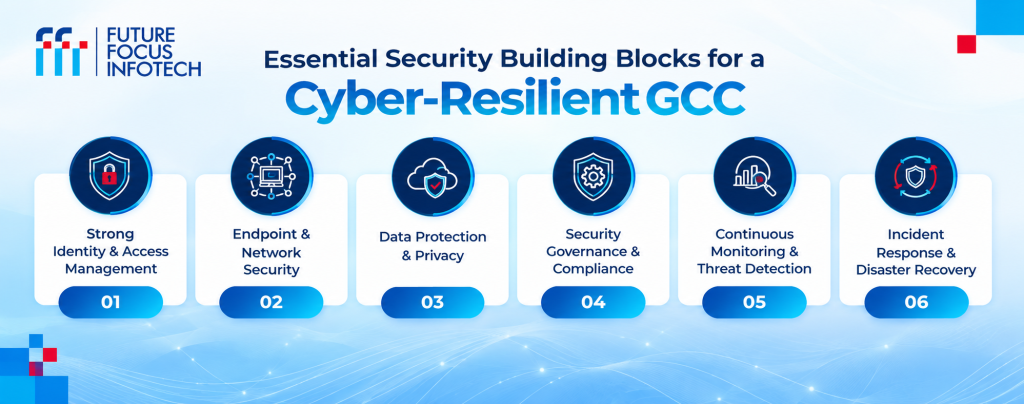
Essential Security Building Blocks for a Cyber-Resilient GCC
Zero Trust Access
Zero trust means every user, device, and session is verified continuously instead of being trusted by default. For a GCC, this ensures that a single stolen password cannot open up the wider network. It is especially important where teams connect across countries and time zones. For a detailed technical reference, see NIST Special Publication 800-207.
Compliance Mapping from Day One
DPDP, GDPR, and sector rules should be mapped to specific security controls before the GCC goes live. Doing this early avoids costly retrofits later. It also gives auditors and regulators a clear record of how each obligation is met.
Unified Identity and Access Management
A single global directory with role-based, least-privilege access ensures employees see only the data their role requires. This reduces unnecessary exposure across teams and geographies. It also makes onboarding and offboarding faster and safer.
Integrated Threat Monitoring
A GCC’s security monitoring should connect in real time with headquarters’ monitoring. That way, threats are detected, triaged, and escalated on one shared timeline instead of through disconnected teams. Many mature GCCs also use this model to provide round-the-clock coverage for the whole enterprise.
Vendor and Supply-Chain Security
Security checks should extend beyond the GCC to every sub-vendor and contractor it works with. Third-party gaps are among the most common entry points for attackers. Regular vendor risk reviews close them before they can be exploited.
Shared Incident Response Playbooks
The GCC and headquarters should agree jointly on response and escalation procedures, not after an incident happens. A shared playbook cuts confusion and response time. It also keeps regulatory reporting within the required windows.
What to Look for in the Best GCC Cybersecurity Partner
Deep Understanding of GCCs, Not Just Security
The best partner knows how GCCs are built and run. They understand where risk tends to build up: talent onboarding, facility access, network setup, and the handover between the parent company and local teams. Security should be part of the GCC blueprint from the planning stage, not added once operations are live.
Clear, Business-Focused Compliance Planning
Ask a prospective partner how they would make your GCC DPDP-ready before May 2027 while keeping it aligned with your home-market regulations. A clear, phased roadmap shows real expertise. A long list of frameworks with no plan behind it does not.
Respect for Your Governance and Authority
A strong partner runs security operations day to day but leaves final decisions with you. Look for a documented governance charter, a joint security steering committee, and contract terms that confirm your authority over security decisions.
Security Built into the People Side
Many breaches begin with people rather than systems, through excessive access, poor offboarding, or untrained staff. A partner who also handles talent can build background checks, security training, and access controls into hiring from day one.
Measurable Service-Level Commitments
Patch timelines, incident-reporting windows, and escalation paths should be written into contracts. They should also be visible on shared dashboards, so both parties work to the same clock and the same data.
Safe Migration and Change Management
Moving data and workloads into a new GCC is one of the riskiest phases. The best partners use phased migration, sandbox testing before go-live, and complete audit trails to keep exposure to a minimum.
Why Future Focus Infotech Is a Trusted GCC Security Partner
Future Focus Infotech (FFI) has worked with global technology businesses for close to three decades. Incorporated in 1997 and ISO 9001 certified since 2005, FFI established offices in the USA in 2000 and the UAE in 2011. That long cross-border experience shapes how FFI helps enterprises build secure, well-governed GCCs.
End-to-End GCC Setup with Security Built In
FFI’s Global Capability Centre services follow a turnkey approach, from strategic planning to facility setup, talent sourcing, and governance. Security controls are designed into each of these stages rather than layered on afterwards.
Comprehensive Information Security Services
FFI’s information security services cover network security, endpoint protection, encryption, and IT asset security. They also include proactive threat detection and regulatory compliance support. This gives GCCs protection across infrastructure, data, and users.
Talent Security from Day One
With its roots in IT staffing, FFI brings a practical understanding of how people-related risks arise. It can build vetted onboarding, role-based access, and secure offboarding into the way GCC teams are hired and managed.
Strategic Advisory for Long-Term Resilience
Through technology consulting and advisory, FFI helps enterprises ensure data integrity, compliance, and security while developing a governance framework. This keeps a GCC’s security posture aligned with changing regulations and emerging technologies such as AI.
Secure Modernisation of Legacy Workloads
When GCCs take over older systems from headquarters, FFI’s digital transformation services help modernise those systems while keeping security and business continuity intact.
Conclusion
A GCC’s value depends on how much trust the parent company can place in it. That trust is earned through sound architecture, clear governance, and disciplined operations, not through audit checklists alone.
With DPDP enforcement approaching and attackers increasingly targeting distributed operations, securing a GCC has become a strategic business decision. The best cybersecurity partner doesn’t just protect your GCC.
They help make it the secure foundation the rest of your enterprise builds on. If you are planning a new GCC or strengthening an existing one, talk to Future Focus Infotech about building a GCC that is secure by design.
FAQs
1. When should cybersecurity planning begin for a new GCC?
Cybersecurity planning should begin before the site is chosen or the first employee is hired. Access design, network architecture, and compliance mapping are far easier and cheaper to get right at the start than to fix once operations are running.
2. Does the DPDP Act apply to GCCs serving overseas parent companies?
GCCs that process digital personal data in India should plan on the basis that the DPDP framework applies, alongside their parent company’s home-market obligations. Because every setup is different, enterprises should confirm their specific obligations with legal counsel.
3. Can a GCC run its own Security Operations Centre?
Yes. Many mature GCCs operate their own Security Operations Centre that works alongside headquarters’ monitoring. This often gives the enterprise round-the-clock coverage across time zones.
4. What makes a cybersecurity partner the best fit for a GCC?
Software, fintech, healthcare tech, e-commerce, and data/AI-driven businesses, since they depend on innovation and quality more than repetitive tasks.
5. How long does it take to set up a secure GCC in India?
It depends on the GCC’s size, scope, and compliance needs. Most setups take a few months, and building security into the plan from day one helps avoid delays later.