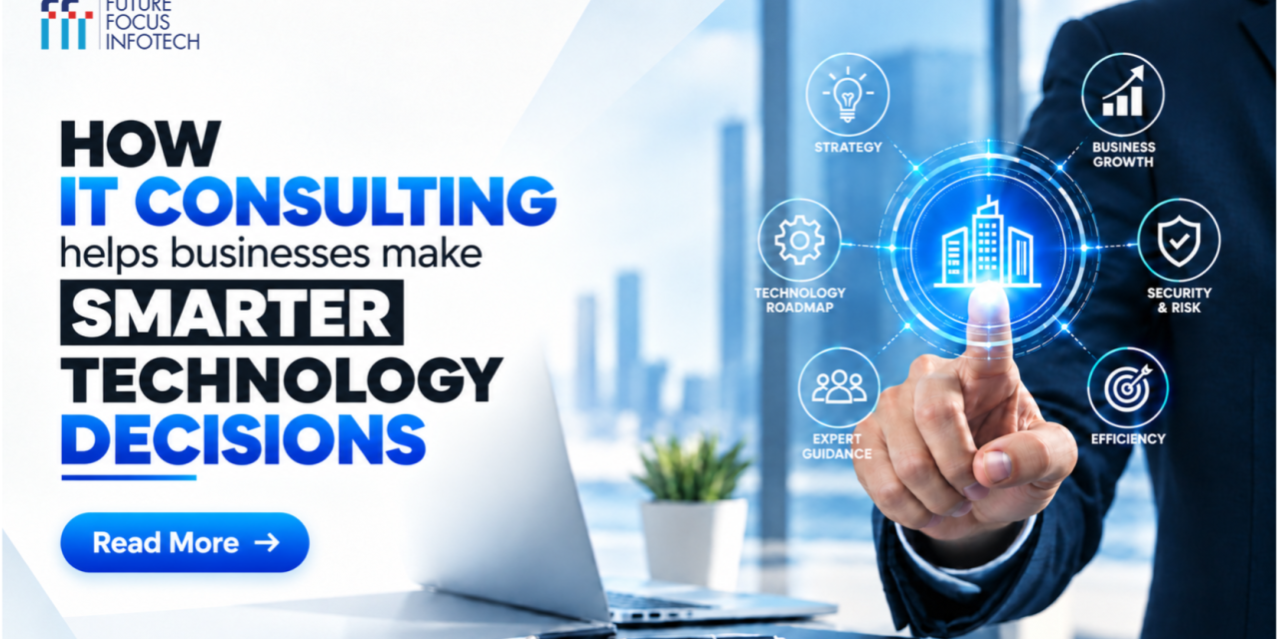
Gartner expects the world to spend $6.37 trillion on IT in 2026. Yet its own analyst warns that this is not a “rising tide lifts all boats” market: the money is flowing to some bets far faster than others. The challenge is no longer finding technology. It is knowing which technology is right for your business.
This newsletter explains what IT consulting is, why technology decision-making is getting harder, and how a step-by-step advisory approach turns technology spend into business value.
In this Newsletter:
1. Technology Decisions Are Now Business Decisions
2. What Is IT Consulting?
3. Why Technology Decisions Are Getting Harder
4. How IT Consulting Helps Businesses Decide Smarter
5. What Smarter Technology Decisions Look Like
6. Conclusion
7. FAQs
1. Technology Decisions Are Now Business Decisions
Technology used to be a back-office purchase. Today it shapes revenue, cost and risk, and the companies growing fastest have noticed. Enterprise IT strategy is now a boardroom topic.
• $6.37 trillion: forecast worldwide IT spending in 2026, up 14.2% on 2025, with growth concentrating in AI-related segments (Gartner, July 2026).
• Nearly two-thirds vs 52%: top-performing companies versus others whose technology leaders are very involved in shaping business strategy (McKinsey Global Tech Agenda 2026).
• Nearly half: top performers whose business and technology teams plan strategy together through the year instead of once a year.
What has changed is the pace and the stakes. Annual planning cycles struggle when AI tools, cloud models and security requirements shift every quarter, and a wrong platform choice can take years and a large budget to undo. Leaders are no longer asking whether to invest in technology, but which investments will still be earning their place in three years. Few organisations have the time, an unbiased view or wide industry experience in-house to evaluate every option well, and that gap is where IT consulting earns its place.
This is the gap Future Focus Infotech’s technology consultation and advisory practice is built around: helping organisations optimise technology investments for sustainable growth, with every recommendation tied back to a business objective rather than a product feature.
2. What Is IT Consulting?
IT consulting, also called technology consulting or technology advisory services, is independent guidance that helps a business decide what technology to adopt, replace, integrate or retire, and in what order. It comes before implementation, answering what and why before anyone builds how. Unlike a vendor, who begins with a product, a consultant begins with your business problem, which is what separates IT consulting services from a sales pitch. A good engagement works across three layers:
• Assessment: an honest starting picture of systems, data, security, spend and gaps.
• Advisory: recommendations tied to business goals, covering technology fit, build-or-buy and total cost.
• Roadmap and oversight: a step-by-step plan with owners, measures and review points, so decisions hold up over time.
In practice, these layers come together across the areas where technology decisions are hardest to get right: cloud and infrastructure, data and analytics, application modernization and security. Future Focus Infotech’s technology consultation and advisory practice is organised around the same areas, with dedicated Cloud Advisory, Cloud & Infrastructure Advisory, Data & Analytics Advisory and Digital Security Advisory. A client can start with a single question, such as whether to move a workload to the cloud, and the advice stays connected to the wider technology setup instead of solving one problem on its own.
3. Why Technology Decisions Are Getting Harder
More options should make choosing easier. In practice, they make it harder. Five pressures show up again and again:

The AI example: McKinsey found that nearly a third of companies struggle with AI talent gaps and with integrating AI into existing systems. Separately, in a Gartner survey of 204 finance leaders, 45% of finance AI investments leaned toward productivity while only 20% leaned toward decision quality, even though boards weigh growth and better decisions more heavily.
Future Focus Infotech’s technology consultants approach these pressures with ROI-focused technology assessments built around the client’s business context, so each option is judged on expected return rather than how new it is. Where risk is high, clear risk-management frameworks, regular audits and step-by-step rollout keep change under control, which means a modernization programme can move forward without putting day-to-day operations at stake.
Individually, each pressure is manageable. Together, they make decisions slow, political and easy to get wrong.
4. How IT Consulting Helps Businesses Decide Smarter
Effective IT strategy consulting moves from understanding to action in five steps:
1. Assess where you stand. A technology assessment reviews applications, infrastructure, data flows, security and spend, producing a factual baseline of what works, what is duplicated and what is a risk.
2. Align technology to business goals. Growth, cost and customer priorities become technology requirements, so every project links to an outcome. This business technology alignment is where FFI’s advisory work starts: with the business question, not the product.
3. Evaluate options before committing. Solutions are compared on fit, integration effort, total cost over its lifetime, ability to grow and the risk of being stuck with one vendor, with small trial runs where the risk is high.
4. Build a practical IT roadmap. Projects are ordered by value and by what depends on what, separating quick wins from longer changes, with budgets and owners attached.
5. Review, secure and measure. Success metrics are set upfront and reviewed regularly. Security is built into the first decision, which is where FFI brings in its information security capability.
The result is a decision record: why a technology was chosen, what it should deliver and how success will be measured.
Where Future Focus Infotech goes further is in what happens next. Because the same organisation delivers technology services, its recommendations are shaped by how systems actually get built, moved and secured. FFI’s teams can help redesign system design to be flexible, ready to grow and cloud-ready, plan phased application modernization, and bring information security into the design from day one, so the roadmap stays workable long after the presentation is finished.

5. What Smarter Technology Decisions Look Like
When decisions follow this discipline, the benefits show up in the business, not just in IT:
• Better investments: spend follows measurable outcomes, the core of a sound technology investment strategy.
• Lower unnecessary cost: fewer duplicate tools and clearer cloud and licence spend.
• Systems that work together: integration is planned before purchase, not fixed afterwards.
• Digital readiness: a foundation prepared for automation and AI, the real goal of digital transformation consulting.
There is also a shift in what efficiency means. McKinsey found that more than half of companies plan to cut IT costs by improving productivity, while only about a quarter will renegotiate with vendors. The main way to cut cost is no longer pushing suppliers on price once a year but making work run more smoothly, which is only possible when technology choices are made with a clear view of workflows, links between systems and ownership.
What to look for in an IT consulting partner. Choosing the right partner matters as much as the decision itself. Look for independence, so recommendations follow your needs rather than a product range; business-first thinking, so outcomes and cost come before features; security considered from the first decision rather than the last; and knowledge sharing, so your own team understands the reasoning and can carry it forward. FFI’s advisory model is built on these principles, which is why engagements start with the client’s business context and not a technology shopping list.
BEFORE YOUR NEXT MAJOR TECHNOLOGY INVESTMENT, ASK:
1. Which business problem does this solve, and who owns the outcome?
2. What is the total cost over three to five years, not just the first year?
3. How will it integrate with our existing systems and data?
4. How will we measure success, and when will we review it?
5. What are the security, compliance and exit risks?
If your team cannot answer these with confidence, that is the moment to bring in an outside perspective.
6. Conclusion
Technology choices will keep growing in number, and the cost of choosing poorly will keep rising. IT consulting does not replace internal expertise; it adds an unbiased view, structure and experience when decisions matter most. By aligning technology with business goals, checking options before committing and tracking outcomes afterwards, organisations spend with intent rather than simply spending more.
That is the discipline behind FFI’s approach to technology advisory: assessment, cloud, data and security advice brought together, so every decision gets clarity first and technology second. Is your next technology decision backed by a clear business case?

FAQs
What is IT consulting?
Independent, step-by-step advice that helps businesses choose, plan and manage technology so it supports business goals, covering assessment, comparing options, roadmaps and ongoing oversight.
How is IT consulting different from working with a technology vendor?
A vendor recommends from its own product range. A consultant starts with your business needs and compares options against them.
When should a business consider IT consulting?
Before a major investment, when systems are scattered or outdated, when costs rise without clear returns, or when leadership needs a strong business case.
Is IT consulting only for large enterprises?
No. Mid-size businesses face the same choices with smaller margins for error and often less time and fewer people, so getting decisions right early matters just as much.
How can FFI help?
As an IT consulting company in India, FFI’s technology consultation and advisory team runs ROI-focused technology assessments, advises across cloud, data and analytics, infrastructure and security, and helps build a roadmap you can act on. To discuss your technology priorities, contact us at www.focusinfotech.com.
Is your technology as ambitious as your business plan? Explore Future Focus Infotech’s digital transformation services at www.focusinfotech.com.
Future Forward is Future Focus Infotech’s newsletter on enterprise technology, digital transformation and the trends shaping business.
Future Focus Infotech Private Limited is a global technology solutions and consulting company helping enterprises accelerate transformation through digital innovation, enterprise applications, cloud, AI, workforce solutions and Global Capability Centre enablement.