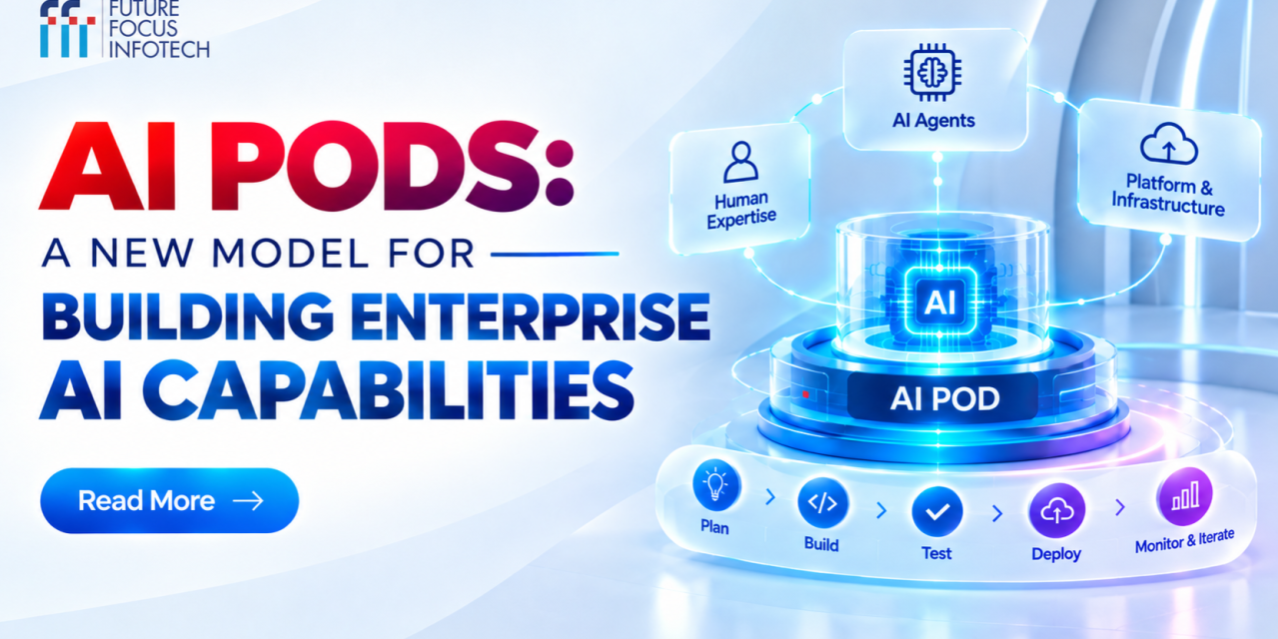
Enterprise AI has moved past the demo stage, boardrooms want production systems, not prototypes. Yet the delivery structures that built enterprise software for decades weren’t designed for this. Global Capability Centers (GCCs) and product teams are testing an agentic AI pod model built for this gap: the AI Pod.
This newsletter unpacks what an AI Pod is, how it works, and where it’s changing how enterprises build production-ready AI systems.
In this Newsletter:
1. Why Enterprise AI Needs a New Delivery Model
2. What Is an AI Pod?
3. Roles in a High-Performing AI Pod
4. Where AI Pods Deliver Best
5. Types of AI Pods and Their Deliverables
6. The Economics: Paying for Outcomes, Not Hours
7. Governance, Security and Observability
8. What’s Next for AI Pods
9. Conclusion
10. FAQs
1. Why Enterprise AI Needs a New Delivery Model
Enterprise AI initiatives fail less because the model was bad, and more because delivery was never built to reach production. CIO.com reports that 88% of AI pilots fail to reach production – a broken handoff, where one team trains, another deploys, and a third owns infrastructure.
The same problem shows up inside teams. Engineering was built like a pyramid – a few seniors, a mid layer, a broad base of juniors. AI-assisted coding inverted that: juniors generate more code, faster, but it needs heavy senior review, so the bottleneck moved from writing code to reviewing it.
This is the gap FFI hears about most: not a shortage of AI tools, but an AI delivery model that turns pilots into governed production systems.
2. What Is an AI Pod?
An AI Pod, also called an AI delivery pod, is a small, self-contained delivery unit – typically three to five senior engineers – paired with AI agents handling the structured, repeatable parts of delivery, built around three coupled layers:
- AI-driven workflows: agents that generate and review code, run tests, draft docs and prepare deployment artifacts.
- Human oversight: senior engineers who align output with business goals and validate quality before anything ships.
- Platform infrastructure: security, multi-cloud deployment, legacy integration, and cost visibility.
- What holds these together is a harness – rules and escalation paths defining what agents can do alone and when a human steps in. Add an assistant to a team, and you get a team with an assistant. Add a harness, and you get a pod: bugs get caught in days, not weeks, and parallel AI agents compress cycle time without adding headcount.
FFI’s engineering and cybersecurity teams build the harness first, so agent-driven speed never outruns what an enterprise can review and govern.
3. Roles in a High-Performing AI Pod
A well-built AI pod team divides labor deliberately: agents own code generation, test scaffolding and deployment prep; humans own architecture and anything where a wrong call is costly. That human layer usually covers:
- A technical lead who translates business objectives into blueprints and owns day-to-day commits.
- An AI/systems architect who picks models and designs the multi-agent and retrieval pipelines.
- A data engineer who pipelines the enterprise’s own data – the input every agent depends on.
- A specialized QA function that tests for hallucination and prompt injection, not traditional pass/fail QA.
Titles vary by provider, but the pattern doesn’t: roles are senior and few, cutting the review overhead pyramid teams generate. FFI structures its pods the same way, pairing senior architects and data engineers with agent-driven workflows.
4. Where AI Pods Deliver Best
The AI pod model isn’t a universal fix. Bain’s analysis finds they’re a strong fit for development, testing and automation, but less proven for UX architecture or strategic product design. Where pods earn their keep:
- Development and deployment: code generation, refactoring and CI/CD are structured enough for agents, with humans owning architecture.
- Automated testing: agents generate and update test suites continuously, catching issues earlier than manual QA.
- Model training and datasets: embedded data engineering handles labeling without a separate, distant data team.
- RAG pipelines: tight coordination between data, prompting and evaluation – exactly what a pod holds in one place.
- Real-time inference: the team that built the model running it shortens the gap between an incident and its diagnosis.
FFI scopes its pods against this boundary – leading with development, testing, data and inference, and leaving strategic product calls with the client’s own leadership.
5. Types of AI Pods and Their Deliverables
Pods are also structured around a specific domain:

Most engagements start with one or two pods against the highest-priority workload and expand as the pattern proves out – a sequencing FFI follows, since adding pods keeps ownership intact in a way scaling one large team usually doesn’t.

6. The Economics: Paying for Outcomes, Not Hours
Traditional services math is expensive: 30% more output means hiring 20–25% more people, with costs scaling right alongside. AI Pods change that, since agents absorb repeatable work, letting a smaller team handle throughput that once needed a much larger one.
This is pushing outcome-based pricing over hourly billing – delivery-time reductions, quality, throughput or shared savings, tracked via a token-based cost layer. Research notes this is driving 20–30% renewal compression, backed by data: digital health rebuilds at roughly half the investment and 1.5x faster, automotive testing 4x faster at over 95% accuracy.
None of this is automatic – consumption-based pricing brings a risk the FinOps Foundation treats as a governance problem: usage spikes that scale API bills exponentially. The fix: semantic caching for repeat queries, and intelligent routing that reserves premium models for complex reasoning.
FFI builds this AI cost-optimization layer into every pod from day one, rather than retrofitting it after a client’s first unexpectedly large invoice.
7. Governance, Security and Observability
AI governance is often mistaken for optional. It isn’t – more autonomy needs more intentional oversight, delivered through:
- Observability into what agents generate and where a human stepped in, so teams can demonstrate compliance.
- Agent-level security, applying the same access controls used for humans to the agents themselves.
- Token transparency, tracking what each workflow costs so billing stays auditable.
- New delivery metrics – throughput, cycle time, defect rate, agent-to-human review ratio – over timeline-based tracking.
This is the layer FFI treats as non-negotiable – building the same AI security discipline from its cybersecurity practice into the agent layer, not bolting it on afterward.
8. What's Next for AI Pods
The AI pod model is early, but points toward durable infrastructure, not a one-off intervention. Enterprises scale by adding pods against new workloads rather than growing one team, keeping ownership concentrated. For GCCs, this makes AI pods in India a practical way to add capacity without growing one large team. Pods built inside a client’s own cloud leave that client owning the resulting IP, and shared, documented ownership means losing one engineer no longer stalls the roadmap.
We design our pods around this continuity from the outset – documented, cross-covered and provider-backed.
9. Conclusion
The reason AI Pods work isn’t a smarter model – it’s the structure itself. Concentrating ownership, embedding agents into the workflow, and measuring output at the pod level turns enterprise AI from a prototype into a production capability.
For FFI, this is the same discipline behind our GCC enablement work: bringing AI, data, cybersecurity and delivery together as one team, so a client manages outcomes instead of people, tools and vendors separately. Ready to stand up your first pod?

FAQs
What is an AI Pod?
A small delivery team combining senior engineers with dedicated AI agents, working inside a harness that decides what agents can do alone and when a human steps in.
How is it different from adding a coding assistant to an existing team?
A coding assistant makes a team faster at the same work. A pod restructures the team: agents take repeatable work, humans handle judgment calls, and the unit is priced as a single outcome.
Where do AI Pods work best?
Development, testing, model training, RAG and real-time inference. Less proven for UX architecture and strategic product design, where judgment matters more than process.
How are AI Pods priced?
Increasingly through outcome-based pricing – delivery time, quality, throughput – measured via a token-based cost layer, rather than by the hour.
How can FFI help?
FFI stands up pods with the harness, cost governance and security built in from the first sprint – AI engineering, data and cybersecurity capability as one accountable delivery unit.
Future Forward is FFI’s newsletter dedicated to enterprise technology, digital transformation, innovation, and the trends shaping the future of business. Subscribe to receive expert insights and practical strategies that help organisations stay ahead in a rapidly evolving digital landscape.