

In this blog:
- Introduction
- What is an ODC and Why the Old Model is Fading
- The Shift: Why Companies Are Moving Beyond Cost-Driven ODCs
- What Makes a Performance-Driven ODC Different
- Outcome-Based Metrics Over Headcount
- Talent That Thinks Like Partners, Not Vendors
- Technology and AI as the Backbone
- Benefits of a Performance-Driven ODC Model
- How FFI Helps Businesses Build Excellence-Driven ODCs
- Key Traits to Look For While Choosing an ODC Partner
- Conclusion
Introduction
For years, an Offshore Development Center (ODC) was seen as one thing only — a way to cut costs. Companies set up ODCs in India and other talent-rich regions to save money on salaries, infrastructure, and operations. It worked. But somewhere along the way, the game changed.
Today, businesses don’t just want an extended team that works cheap. They want a team that works smart, delivers real value, and moves the needle on business outcomes. This is where the idea of a performance driven ODC comes in — a model that replaces the old “cost center” thinking with a new “excellence center” mindset.
In this blog, we’ll break down what this shift really means, why it’s happening now, and how companies like FFI are helping businesses turn their offshore setups into genuine growth engines.
What is an ODC and Why the Old Model is Fading
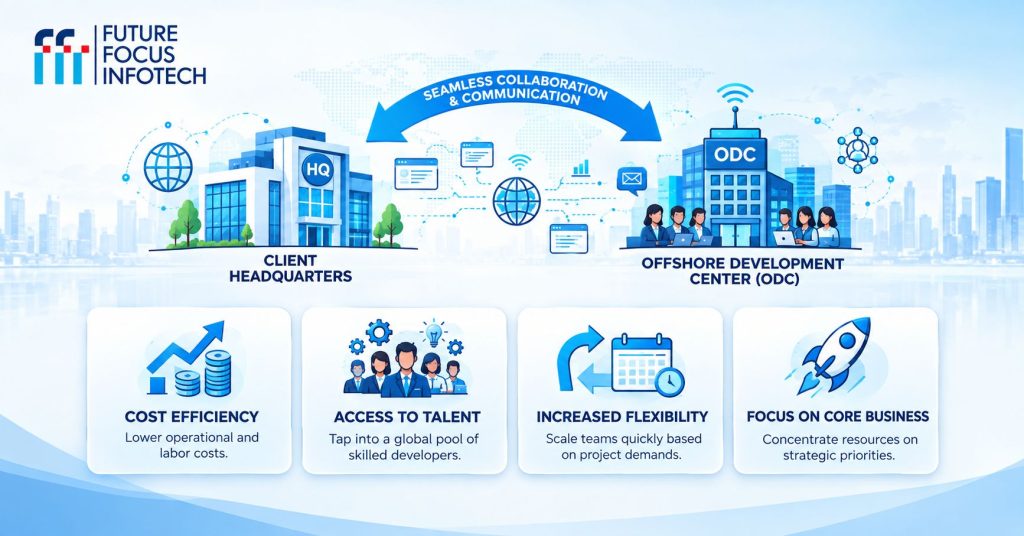
An Offshore Development Center is a dedicated team, usually based in a different country, that works exclusively for one client. Unlike freelancers or short-term outsourcing, an ODC functions like an extension of the client’s own in-house team — same processes, same tools, same goals, just a different location.
For a long time, the pitch around ODCs was simple: “Same work, lower cost.” Businesses set up ODCs in India mainly because labor was cheaper there compared to the US, UK, or Europe. This is very similar to how Global Capability Centres in India started out decades ago — as low-cost, back-office support units.
But cost alone doesn’t build long-term value. As global markets got more competitive and technology moved faster, companies realized that a purely cost-focused ODC often meant:
- High employee turnover due to low investment in people
- Limited innovation because teams were treated as “extra hands,” not thinking partners
- Communication gaps that slowed down projects instead of speeding them up
- Quality that dipped whenever cost pressure went up
This is exactly why the old model is fading, and a new one is taking its place.
McKinsey’s research shows offshore teams are moving from execution to transformation, taking on strategic roles once reserved for headquarters — the same shift now reshaping ODCs.
The Shift: Why Companies Are Moving Beyond Cost-Driven ODCs
Three big forces are driving this change:
1. AI is changing what “value” means. Routine, repetitive tasks are getting automated fast. What businesses need now is deep engineering skill, data expertise, and problem-solving ability — not just cheap manpower. This mirrors what we’ve already seen in fields like AI-powered data science services, where the real value comes from smart, skilled teams building models and solving business problems, not just processing data.
2. Businesses want speed and quality, not just savings. In a fast-moving market, a slow but “cheap” team can actually cost more in missed opportunities than a slightly costlier but faster, high-quality team.
3. Talent expects to be treated as a partner. Skilled engineers and developers today want ownership, growth, and meaningful work — not just a paycheck. Companies that treat their ODC as a real extension of their culture retain better talent and get better output.
Together, these shifts have pushed forward a new standard: the performance driven ODC model.
What Makes a Performance-Driven ODC Different
1. Outcome-Based Metrics Over Headcount
In the old model, success was measured by how many people were “on the bench” and how low the hourly rate was. In a performance-driven ODC, success is measured by outcomes — project delivery timelines, product quality, customer satisfaction, and business impact.
This means clients don’t just track hours logged; they track results delivered.
2. Talent That Thinks Like Partners, Not Vendors
A performance driven ODC hires and nurtures talent that understands the client’s business, not just the client’s tech stack. These teams are trained to think about “why” a feature matters to the end user, not just “how” to build it. This partnership mindset is what turns an ODC from a support function into a strategic asset.
3. Technology and AI as the Backbone
Modern ODCs are built around automation, AI tools, and data-driven decision-making. Instead of manual, repetitive processes, teams use smart tools to speed up development, catch errors early, and continuously improve quality. This is very much in line with how AI is reshaping global capability centers across India, moving them from “execution hubs to genuine “innovation engines.
This is echoed in Gartner’s and Accenture’s analysis of offshore delivery models, which point to skilled talent access and outcome-based delivery
Benefits of a Performance-Driven ODC Model
Here’s what businesses actually gain when they move to this model:
- Better ROI, not just lower cost — you pay for outcomes, not just hours
- Faster time-to-market because skilled, motivated teams solve problems quickly
- Lower attrition since talent feels valued and invested in
- Stronger innovation as teams are empowered to suggest improvements, not just follow instructions
- Scalability with quality, so growth doesn’t mean compromise
- Better alignment with global business goals, not just local delivery targets
In short, a performance-driven ODC doesn’t just save money — it makes money work harder for the business.
How FFI Helps Businesses Build Excellence-Driven ODCs
At FFI, we’ve seen this shift happen up close. Businesses no longer come to us just asking, Can you build our ODC cheaper? They ask, Can you build our ODC better?
That’s the exact question a performance driven ODC model is designed to answer. Our approach focuses on:
- Right-fit talent selection, not just quick staffing, so teams match the client’s technical and cultural needs
- Transparent, outcome-linked reporting, so clients always know the real business impact of their offshore team
- Continuous upskilling, so teams stay ahead of changing technology, especially in AI, data, and cloud
- Strong communication frameworks, closing the distance gap that often hurts offshore collaboration
- Flexible engagement models, so businesses can scale their ODC up or down based on actual project needs
This is the same philosophy driving India’s broader Global Capability Centre boom, where centers are increasingly built around innovation, product engineering, and long-term strategic value rather than short-term cost savings.
Conclusion
The days of viewing an ODC as just a “cost center” are numbered. Businesses today need offshore teams that think, innovate, and deliver — not just teams that work for less. The rise of the performance driven ODC model reflects a bigger shift happening across the industry: from cutting costs to creating real, measurable excellence.
If your business is ready to make this shift, talk to our team about building a performance-driven ODC tailored to your goals. At Future Focus Infotech, we help businesses make exactly that shift — building ODCs that don’t just save money, but actively drive performance, innovation, and long-term success.
FAQs
1. What is a performance-driven ODC?
A performance-driven ODC (Offshore Development Center) is an offshore team model that focuses on measurable business outcomes — like delivery speed, quality, and innovation — instead of just tracking headcount or hourly cost savings.
2. How is a performance-driven ODC different from a traditional ODC?
Traditional ODCs focus on cost savings and staff numbers. Performance-driven ODCs focus on outcomes, using skilled talent and AI tools to deliver real business value.
3. Why are companies moving away from cost-focused ODCs?
Automation now handles routine work, so businesses need speed, quality, and innovation — things a cost-only model can’t consistently deliver.
4. What industries benefit most from a performance-driven ODC model?
Software, fintech, healthcare tech, e-commerce, and data/AI-driven businesses, since they depend on innovation and quality more than repetitive tasks.
5. How can a business set up a performance-driven ODC?
By choosing a partner that prioritizes talent quality, outcome-based reporting, AI adoption, and strong communication — like Future Focus Infotech.